Blueprint
Culture · Blueprint
Values Evolution Blueprint
Open Org's 7-step approach to values design and evolution. Move from words on a wall to co-created behaviours, do's and don'ts, and a practical plan to embed values across your organisation.
Welcome
This blueprint is how Open Org helps companies step away from values as posters, toward clear behavioural statements and values that are operationalised across teams. It is a high-level project structure you can run over roughly four weeks, with templates for comms, surveys, workshops, and embedding.
Work through the seven steps in order over roughly four weeks. Each step includes Open Org guidance, templates you can copy, and a checklist to keep the project on track.
When you are ready to run this for real, hit Help me run this as a project for my org at the bottom of the page. Open Org AI Coach will walk you through all seven steps with drafts and checklists tailored to your organisation.
Project outcome
A co-created set of core values and behaviour statements built with all voices. Inclusive design that gives you firm foundations to operationalise into decision-making, meetings, personal development plans, 1:1 templates, and more.
Open Org's 7-step approach
A high-level structure for a values design project. Jump to any step for guidance, templates, and checklists.
Step 1
Org-wide comms
Set context and explain why values work is happening now.
Step 2
Concise powerful survey
Gather behavioural signals, not abstract word lists.
Step 3
Data aggregation and synthesis
Turn raw responses into themes the org can react to.
Step 4
Playback to whole org
Share findings and invite people into workshops.
Step 5
Workshops to unpack
Facilitated sense-making in small groups.
Step 6
Publish version 1 for feedback
Share a draft and collect structured input.
Step 7
Publish roadmap for operationalising
Signal what happens next and how values show up in daily work.
Step 1 of 7
Org-wide comms
Message: Why are we doing this, why now, and how we will avoid this being words on a wall
Action: Craft the comms
Templates and examples
 Slack message draft (warm-up)Expand
Slack message
Hey team!

As we are {insert business context}, we wanted to take a minute to reflect on our core values and behaviours, aka how we do our best work together here at {Company Name}. It is especially important right now for us to align on this because {insert reason + CEO quote}.

We are going to approach this in 3 parts:

1. Part 1: A short survey to gather your thoughts and reflections (this week)
2. Part 2: A series of group workshops to unpack this (this month)
3. Part 3: Draft feedback, launch and documentation ({insert month})

We will be launching the survey tomorrow so look out for that in {insert slack channel}. The survey will be open for 3 days until {insert date and time}.

We will read every response. Responses are anonymous and we will share the results as we progress through this piece of work.

Thanks,
Your name
Slack message draft (survey launch)Expand
Slack message
Hey team!

As part of our values design project that I mentioned yesterday {link to previous message}, I am excited to share the survey for part 1 of 3.

Why: {reinforce business context, e.g. importance for the business to look at this now}
What: an opportunity for you to shape the design of our future culture at {Company Name}
How: please take some time to complete the survey below. It should take about 10 minutes.

Survey here [link]

This will be open for the next 3 days until {insert date and time}. Responses are anonymous, and we will read every single one. The insights will directly feed the group workshops we run later in the month to design our new values.

Thank you,
Your name
See how others do it
Checklist for this section
- Warm-up message sent with business context and CEO or leadership quote
- Survey launch message with clear why, what, how, and deadline
- Comms posted in the channels your org actually uses
- Single project page or doc linked from every message
Step 2 of 7
Concise powerful survey
Message: Focus on behaviours and collaboration, what is holding us back, what we should protect
Action: Design Typeform survey and comms (Slack + email)
Templates and examples
Values design survey questionsExpand
Core questions (blend EVP and values design)
- -Think of someone on your team you have admired recently. What made you think of them? What words would you use to describe how they work?
- -What day-to-day behaviours on your team inspire you?
- -What behaviours do not work well here?
- -When have we done our best work together? What made it possible?
- -When have we not done our best work together? What got in the way?
Reference
Open Org sample Typeform: https://form.typeform.com/to/vBaVD5T8
See how others do it
Checklist for this section
- Survey designed in Typeform or equivalent
- Core behaviour and collaboration questions included
- Launch comms aligned with step 1 messaging
- Clear close date and anonymity statement
Step 3 of 7
Data aggregation and synthesis
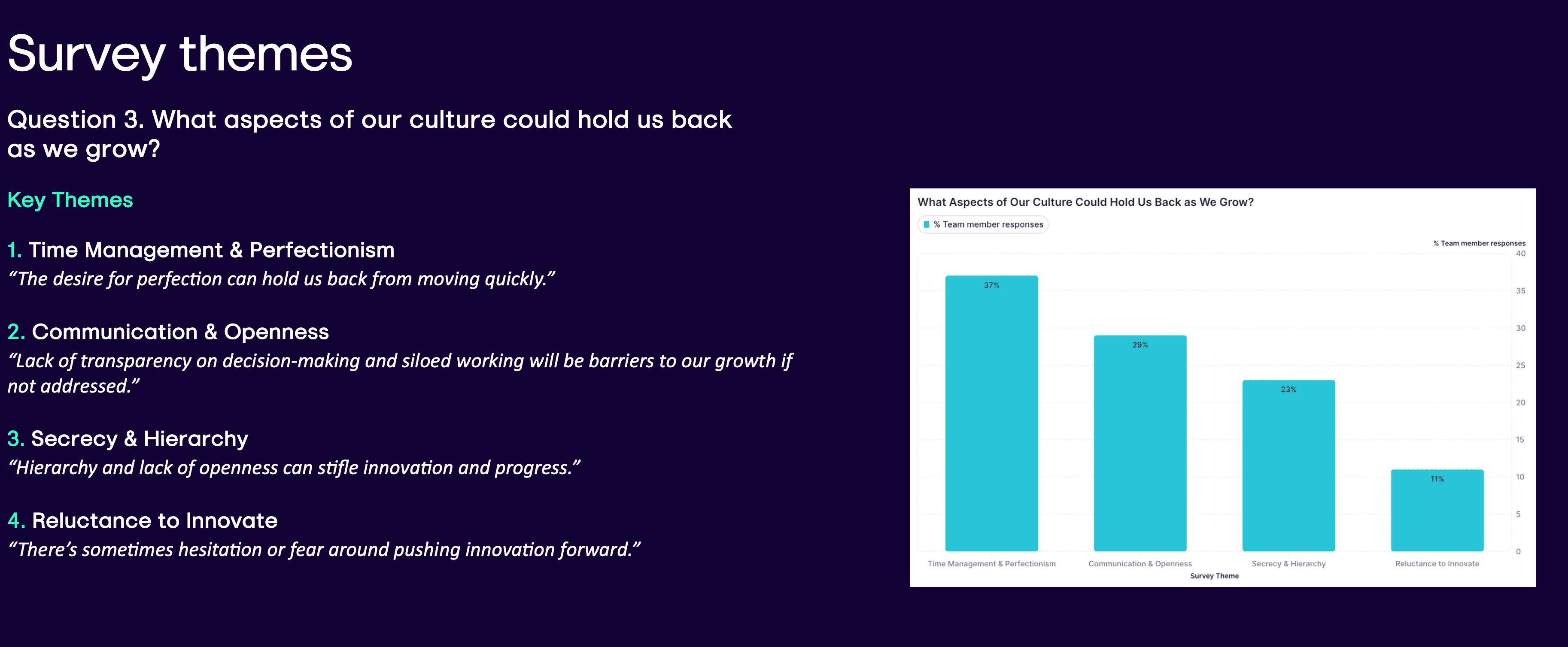
Action: Aggregate qualitative and quantitative results into a clear summary (Notion page or deck)
Checklist for this section
- Themes named in plain language employees would use
- Supporting quotes and data points included
- Summary published in an accessible format (Notion, deck, or PDF)
- People team has reviewed for sensitivity before wider share
Step 4 of 7
Playback to whole org
Message: Share the summary and tee up sense-making workshops
Checklist for this section
- Org-wide playback comms or all-hands slot scheduled
- Summary shared with link to full synthesis
- Workshop sign-up or nomination process explained
- Timeline for steps 5-7 confirmed
Step 5 of 7
Workshops to unpack
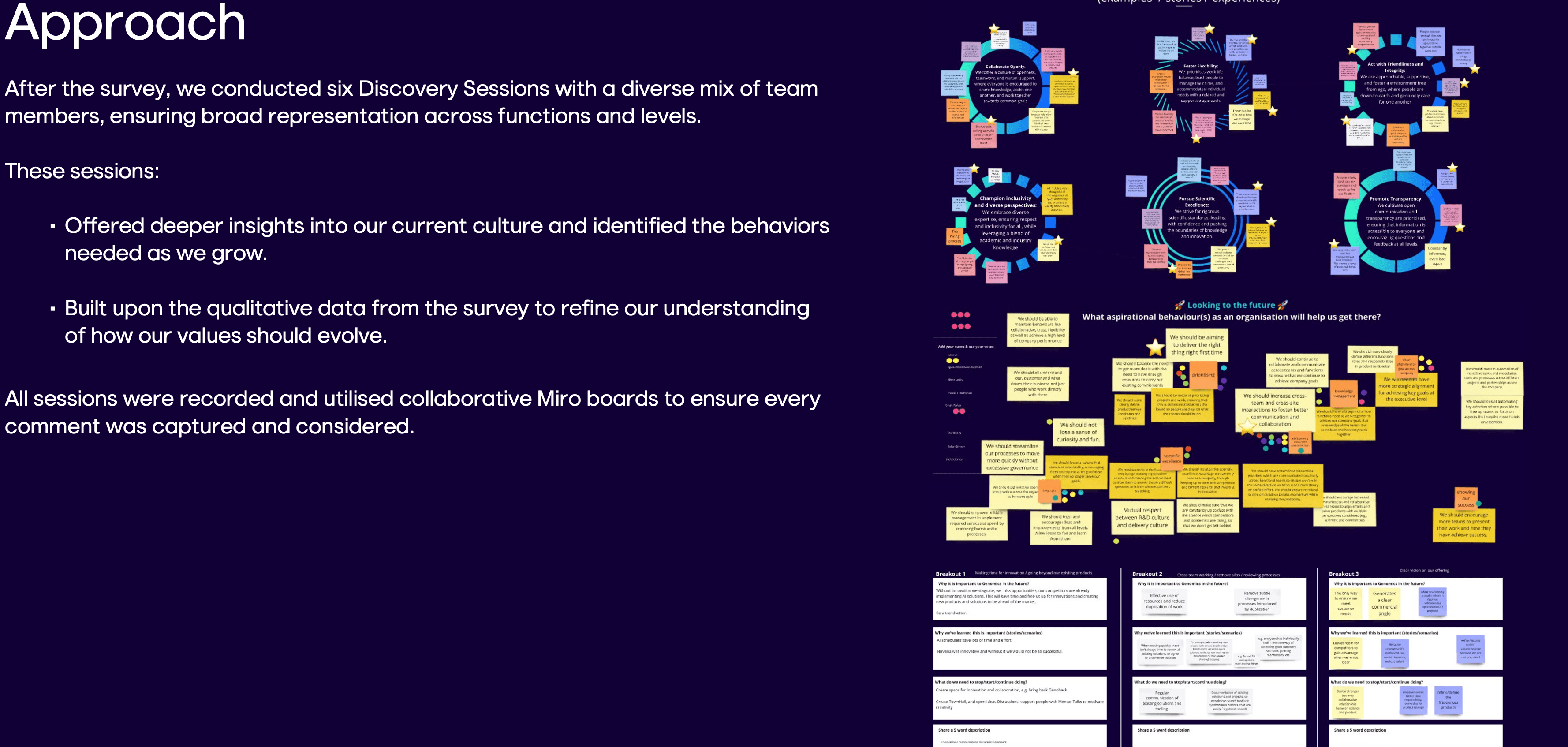
Message: 2-5 x ~10 person workshops to unpack findings and shape value themes, stories, and behaviours
Action: Miro board prep and facilitation support
Templates and examples
Facilitation guide: uncovering operating principlesExpand
Objective
Guide the team through a structured sense-making session using the survey data to uncover the operating principles that define how we do our best work.
Pre-session preparation
- -Notion memo: ensure attendees have reviewed aggregated survey results
- -Miro column 1: Key themes from survey (pre-filled)
- -Miro column 2: Operating principles drafts (co-created)
- -Miro column 3: Concrete behaviours as do's and don'ts
1. Framing and intent (5 min)
Welcome and purpose: we are here to translate our values into clear operating principles that guide how we work best together. Rules of engagement: focus on synthesis, not debate. Prioritise clarity over perfection.
2. Pattern recognition (15 min)
- -Silent sorting: participants place sticky notes under relevant key themes
- -Cluster and name: refine clusters with short, memorable phrases
- -Dot voting: 3 votes each for the most important themes
3. Drafting operating principles (20 min)
- -Small groups select 1-2 themes and draft an operating principle (simple, action-oriented)
- -Principles should answer: how do we work best? What do we need to be successful?
- -Share back and iterate, then dot vote (3 votes each)
4. Making it actionable (15 min)
- -For each principle: what does this look like in practice?
- -Express behaviours as do's and don'ts (e.g. Do: give constructive feedback in real time. Don't: store up feedback for annual reviews.)
- -Dot vote to identify the 3-5 most critical behaviours
5. Close and next steps (5 min)
Summarise top principles and behaviours. Outline next steps (refining wording, testing with broader teams). Confirm how principles will be embedded.
Facilitator tips
- -Keep discussions focused with timeboxing
- -Push for specificity, avoid generic statements
- -Encourage all voices and balance participation
- -Capture everything and use dot voting for consensus
Checklist for this section
- Miro board or equivalent prepped with themes from synthesis
- Facilitation guide shared with co-facilitators
- 2-5 workshops scheduled with cross-functional representation
- Do's and don'ts captured for each principle
Step 6 of 7
Publish version 1 for feedback
Message: Share first draft org-wide and engage leaders to encourage team feedback
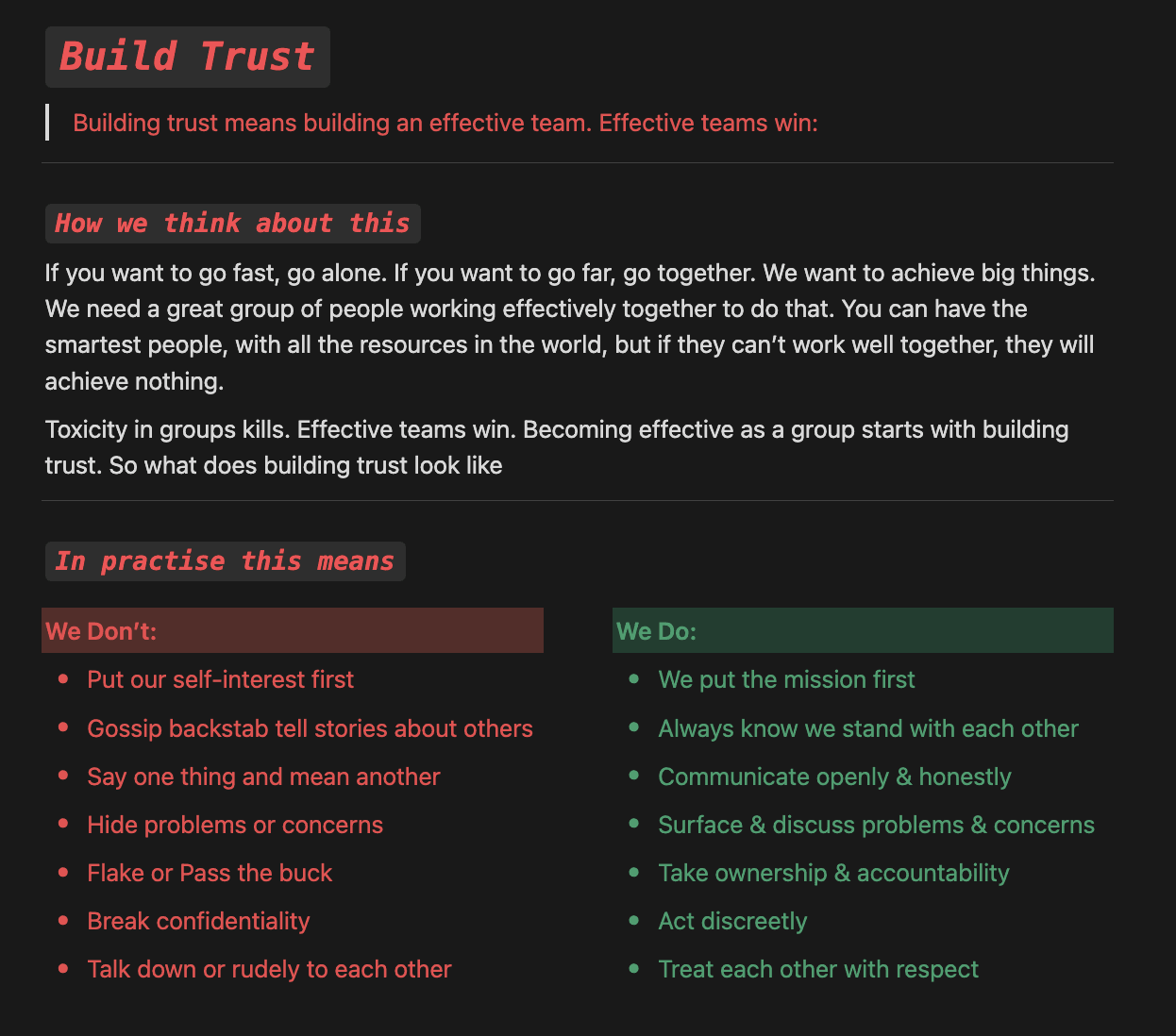
Action: Word-smith values statements and do's and don'ts, collate feedback, revise to final draft
See how others do it
Checklist for this section
- V1 published in a format teams can comment on
- Leaders briefed to collect feedback from their teams
- Feedback window and process made explicit
- Final draft timeline communicated
Step 7 of 7
Publish roadmap for operationalising
Message: People team shares update and signals how values will be embedded
Action: Comms, sequencing, and prioritisation
Checklist for this section
- Final values published and celebrated org-wide
- Embedding roadmap shared with owners and timelines
- First 2-3 operationalisation priorities named
- Quarterly pulse or check-in planned to measure adoption
Operationalising your values
Step 7 is about signalling what happens next. This roadmap illustrates the many ways you can embed values across the employee lifecycle. Pick a few that matter most for your stage. Do not try to do everything at once.
Recruitment and hiring
- Values-based hiring scorecard: Interviewers assess candidates on alignment with company values for better culture fit
- Structured interview question bank: Standardised, values-driven behavioural questions to reduce bias
- Hiring manager training on values alignment: Managers identify and assess candidates who align with values
- Candidate experience guide: Candidates experience values from first touchpoint onward
Performance and retention
- Values-embedded performance review templates: Evaluate how results are achieved, not just outcomes
- Promotion and career progression criteria: Define how demonstrating values impacts advancement
- Employee recognition and reward programme: Celebrate people who consistently live the values
- Manager playbook for coaching and feedback: Reinforce values in everyday coaching conversations
Leadership and development
- Manager and leadership training on living the values: Equip leaders to model and reinforce values
- Values-driven decision-making framework: Reference core values when navigating tough trade-offs
- Onboarding programme reinforcing core values: New hires integrate values from day one
Culture and employee engagement
- Quarterly values pulse survey: Measure how well values are understood and lived
- All-hands and town hall integration: Leadership ties updates to core values
- Internal communications and values messaging: Regular storytelling around values in action
More open resources
Other free templates and diagnostics from Open Org.
Transparency Charter Template
Pairs well with values work: define what openness means and what stays closed.
Compensation Philosophy Template
Design and document how your organisation pays people, with handbook examples and checklists.
Communication Blueprints
Choose the right communication mode for any people moment, from all-hands to difficult conversations.
Transformation Playbook
Eight-stage blueprint for embedding values and behaviours through lasting change.
Culture Heatmap
Score 29 culture statements across nine areas to see where your organisation is thriving.
Want help applying this in your org?
Join Open Org WorkspaceOpen Org Values Evolution Blueprint. Adapt freely for your organisation.