Playbook
People · Playbook
Proving ROI on People Initiatives
A care package for quantifying people work, communicating value to leadership, and securing the resources to execute.
Welcome
This care package was built by the Open Org Community for our Q4 2024 hackathon. Use it when you need to decide what to prioritise, make the business case, and get buy-in for people initiatives.
Work through the problem framing, value quantification, communication framework, buy-in decision tree, and a high-level business case outline. Diagrams from the original care package are included below.
The problem
It’s hard to quantify and communicate the value of people initiatives to exec teams and stakeholders, which in turn makes it difficult to ensure adequate resources are allocated to them.
Who is this for?
People teams who need to:
- 1Decide which initiatives to prioritise.
- 2Communicate the value of those initiatives to leadership.
- 3Secure resources to execute and sustain their goals.
Quantifying the value of people initiatives
Quantifying people initiatives means translating qualitative improvements into measurable impacts on business outcomes.
Step 1
Link outcomes to business metrics
- Improved retention → Reduced hiring costs.
- Faster decision-making → Increased revenue from shorter time-to-market.
- Enhanced engagement → Higher productivity.
Step 2
Choose measurable metrics
- Time savings (e.g. fewer hours in meetings).
- Cost reductions (e.g. lower attrition costs).
- Revenue impact (e.g. increased output from engaged employees).
Step 3
Calculate costs and gains
- Use a simple ROI formula: ROI = (Gains − Costs) / Costs
ROI = (Gains − Costs) / Costs
ROI calculator
A calculator for common people initiatives (e.g. onboarding, feedback culture), with customisable fields adapted to your initiative. Built against the Open Org Culture OS areas. Pairs with the Open Org Culture Heatmap.
Open the ROI calculator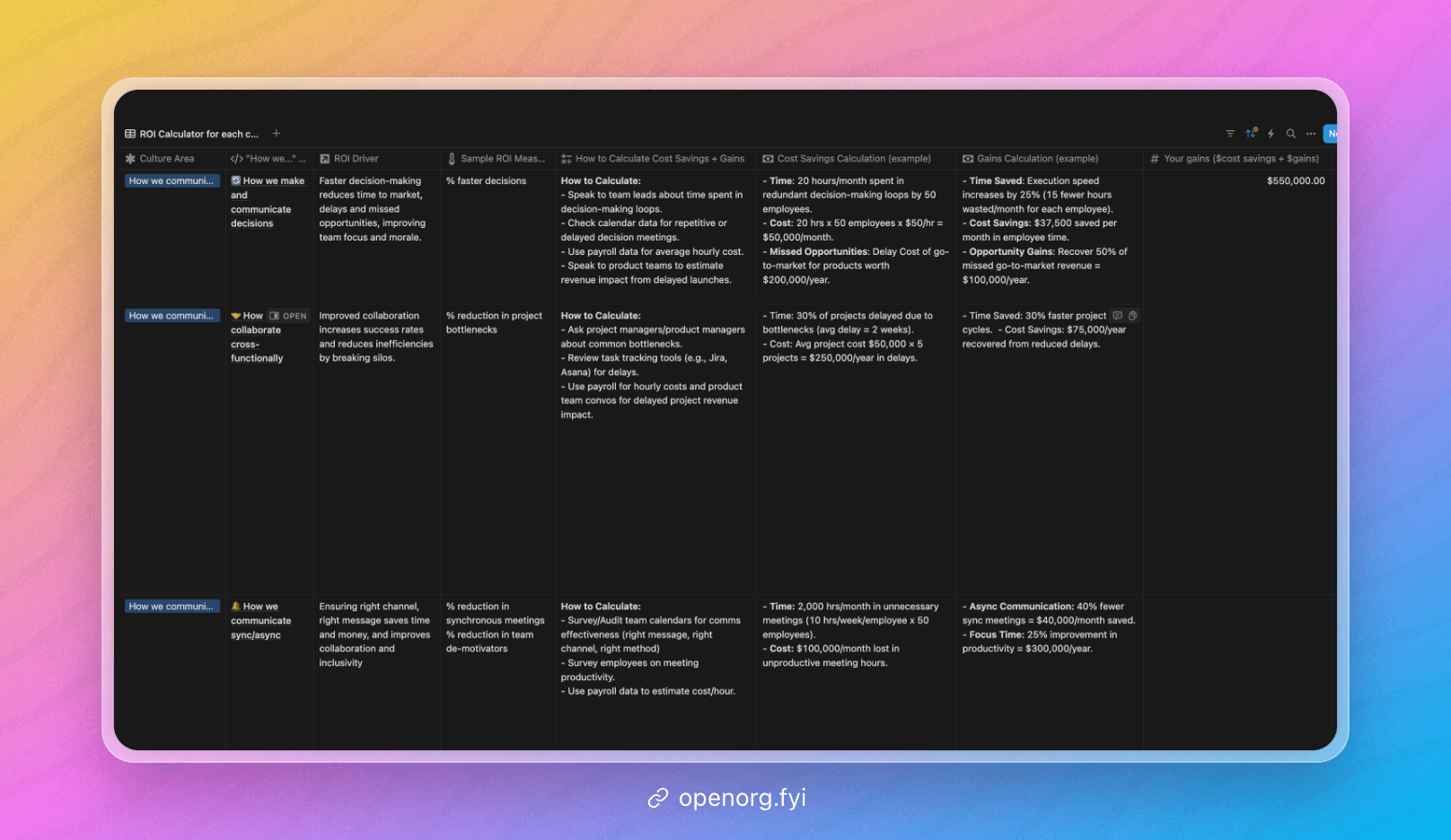
Communicating value
Different types of value: a framework for thinking about improvements to your people product. To help prioritise anything beyond “Because it’s the right thing to do”.
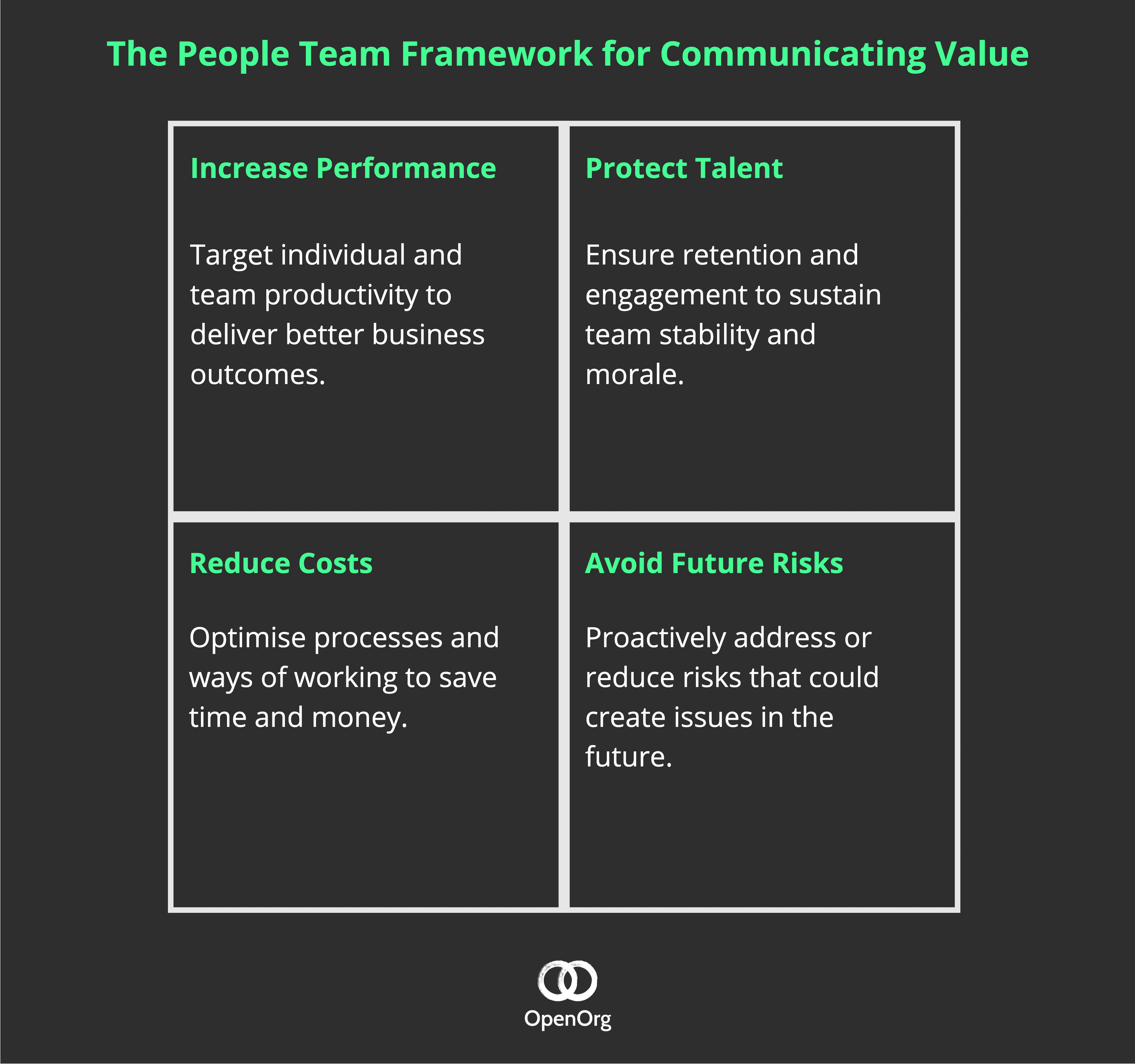
Increase Performance
Drive individual and team productivity to deliver better business outcomes.
Examples: Faster decision-making, streamlined processes, improved collaboration.
Protect Talent
Ensure retention and engagement to sustain team stability and morale.
Examples: Career development programs, employee well-being initiatives, manager training.
Reduce Costs
Optimise processes to save time and budget.
Examples: Automated onboarding, efficient meeting practices, reducing cost of hire.
Avoid Future Risks
Proactively address areas or reduce risks that could create issues in the future.
Examples: Pay transparency legislation alignment, business continuity risk reduction, leadership development, key person dependency mitigation.
Securing buy-in
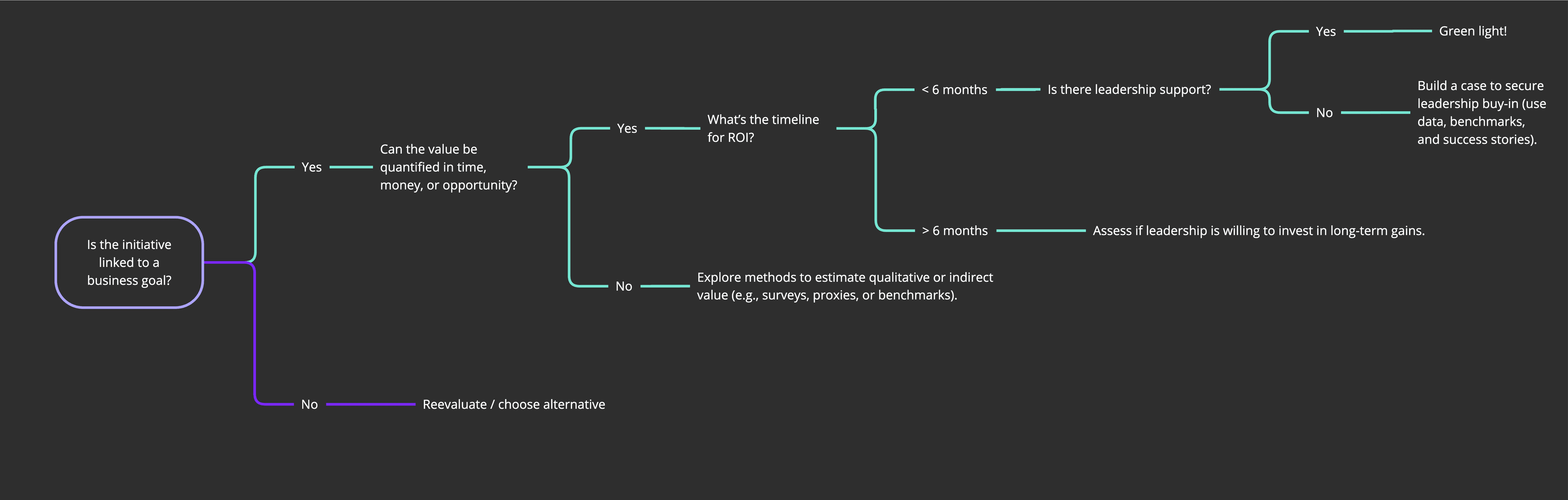
Use this decision tree to guide your thinking before you build the full business case.
- 1Is the initiative linked to a business goal?
- 2Can the value be quantified in time, money, or opportunity?
- 3What’s the timeline for ROI?
- 4Is there leadership support?
Business case template
High-level outline to structure your proposal.
1. Problem statement
- What’s the issue?
- What’s the root cause?
- What’s its impact on the business (e.g. cost, risk, speed, revenue)?
2. Proposed solution
- What’s the initiative?
- What alternatives did you discard and how does it address the root cause?
- What measurable impact do you expect?
3. Benefits
- Tangible: e.g. cost savings, time saved, increased revenue.
- Intangible: e.g. enhanced employee experience, stronger culture, improved leadership trust, improved innovation.
4. Cost estimate
- Include direct costs (e.g. training, tools) and indirect costs (e.g. time spent).
5. ROI
- Quantify gains relative to costs.
- Communicate the payback period (if the project costs $20k, when will you realise $20k of value?).
6. Implementation plan
- High-level steps and timeline for execution.
Useful resources
Reads, tools, and playbooks for identifying, communicating, and measuring ROI on people initiatives.
Urgency profiles
Black Swan Farming
Employee experience ROI
Diversio
How to use data & storytelling to get heard
MembersOpen Org playbook
Open Org Workspace membership required. You will be asked to sign in.
5 Whys
Atlassian Team Playbook
People Metrics
Benchmark startup people and talent metrics
Good to Great
Jim Collins
ROI spreadsheet example
Google Sheet
Cracking employee lifetime value (eLTV)
Peerful / Medium
Contributors
Special thanks to the Open Org Community members who contributed to this care package.
More open resources
Other free templates and diagnostics from Open Org.
Want help turning this into your business case?
Help me build an ROI caseBring your initiative, costs, and expected gains, then draft a leadership-ready outline from the template above.
People Playbook: Proving ROI on People Initiatives by the Open Org Community. Free to use and adapt.